 mcpfold
mcpfold — one MCP config for every client
mcpfold is a free, open-source CLI that manages your MCP servers from one canonical config and folds it out to every MCP client — Claude Code, Claude Desktop, Cursor, VS Code, Windsurf, and Zed — each in its own format.
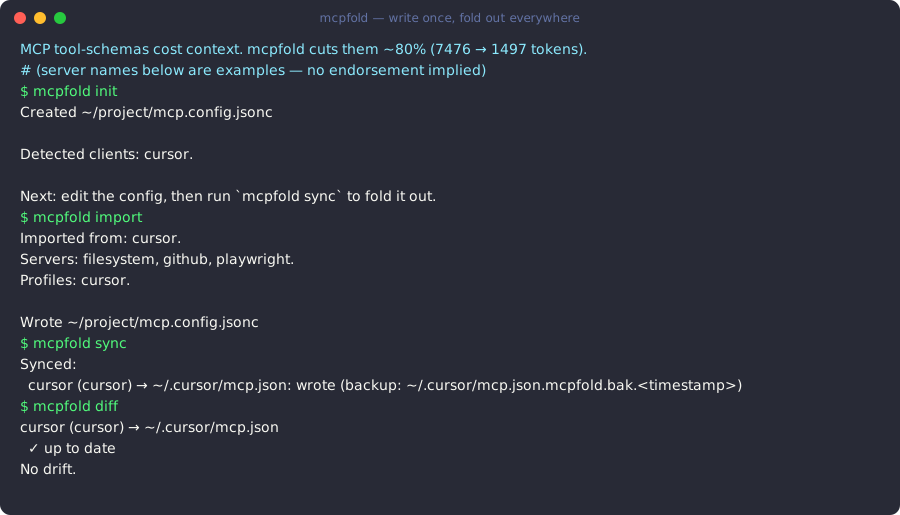
Curate each server’s tools to skip the context-window tax — every server dumps its full tool schema into context, used or not. Curating the toolset cuts tool-schema tokens by ~80% (7,476 → 1,497), with secrets kept as ${env:…} references, never hardcoded values.
npx mcpfold init
Feel the tax — and the savings
Pick your servers and how many tools each agent actually needs. Example servers from the published benchmark — no endorsement implied.
Manage every MCP server from one file
Write your MCP servers once in a single canonical mcp.config.jsonc — the source of truth mcpfold folds out to every client. Add, curate, and version your MCP config in one place instead of hand-editing a different file for each tool.
Works with every MCP client
mcpfold renders each client's own native format from one config, so the same MCP servers show up everywhere:
Curate tools, cut the context-window tax
Every MCP server dumps its full tool schema into the model's context whether you use those tools or not. mcpfold lets you allow- or deny-list tools per server, so only what you need loads — the committed benchmark shows the token savings.
Secrets as references, never values
Your MCP config carries ${env:…} / ${op:…} references instead of raw tokens, so nothing sensitive is ever written to a client config or committed to git. mcpfold resolves the reference at fold time, from your environment or secret manager.
Explore mcpfold
- Install — npx, npm, Homebrew, or Scoop — no account needed.
- MCP server directory — browse and add community MCP servers.
- Documentation — config format, secrets, adapters, CLI contract.
- Pricing — free CLI (MIT); optional paid cloud for teams.
Frequently asked questions
- What is mcpfold?
- mcpfold is a free, open-source CLI that keeps one canonical config for your MCP (Model Context Protocol) servers and folds it out to every client — Claude Desktop, Claude Code, Cursor, VS Code, Windsurf, Zed, and more — each in its own native format. You write your servers once; mcpfold renders the right file for each tool.
- How does mcpfold handle secrets?
- mcpfold stores secrets as references (for example ${env:GITHUB_PAT} or ${op:vault/item/field}), never as raw values. The reference is the only thing committed to git; the actual secret is resolved from your environment or secret manager at fold time, so credentials are never written to a client config on disk.
- Which MCP clients does mcpfold support?
- mcpfold folds to 12 clients from one config: Claude Desktop, Claude Code, Cursor, VS Code, Windsurf, Zed, Cline, Gemini CLI, JetBrains AI Assistant, Visual Studio, Continue, and Roo Code. Each client has its own config format and path; mcpfold handles the per-client dialect automatically.
- Is mcpfold free?
- Yes. The entire mcpfold CLI — every adapter, the canonical config, secret references, sync, diff, doctor, and the config-as-code CI gate — is free and open source under the MIT license, with no account required. Optional paid cloud features add team config sharing, roles, and an audit trail.